
| |
Report roadmap: Message from Durham Region's Medical Officer of Health, acknowledgements and report overview. | |
Understanding climate change: What factors cause climate changes and the impacts of these changes now and in the future. | |
Climate change and health: The health impacts of climate change, factors of vulnerability, and the need for an equity-focused approach. | |
The way forward: How health can be integrated into climate risk; including plans and methodology for Durham Region's assessment. | |
Durham's setting: An exploration of how Durham Region's rich and varied landscape influences and is affected by climate change. | |
Portrait of community: A detailed overview of the unique characteristics and needs of Durham Region's diverse and growing population. Includes appendices. |
Climate Change and Health
Climate Change and Health in Durham Region
A report series on local health impacts
To help learn, prepare for and act against climate change, Durham Region Health Department has launched a special series on climate change and health. Our first report is a background primer called Understanding the Local Health Impacts of Climate Change. More reports will be released as they are ready, focusing on extreme heat, solar ultraviolet radiation, vector-borne disease, poor air quality, extreme weather, and food and water impacts.
Background Primer: Understanding the Local Health Impacts of Climate Change
Extreme heat and health in Durham Region
The Assessing the Impact of Extreme Heat vulnerability assessment explores current and future local health impacts of extreme heat.
Solar ultraviolet radiation in Durham Region
The Assessing the Impact of Solar Ultraviolet Radiation vulnerability assessment explores current and future local health impacts of solar ultraviolet radiation.
Download the Assessing the Impact of Solar Ultraviolet Radiation report
Vector-borne Disease (VBD) in Durham Region
The Assessing the Impact of Vector-borne Disease (VBD) vulnerability assessment explores current and future local health impacts of VBD.
Download the Assessing the Impact of Vector-borne Disease (VBD) report
Read the latest report in this series
Air quality risks in Durham Region
To help learn, prepare for and act against climate change, Durham Region Health Department has released the report, Assessing the Impact of Poor Air Quality as part of the series Climate Change and Health in Durham Region.
This vulnerability assessment explores current and future local health impacts of air pollution.
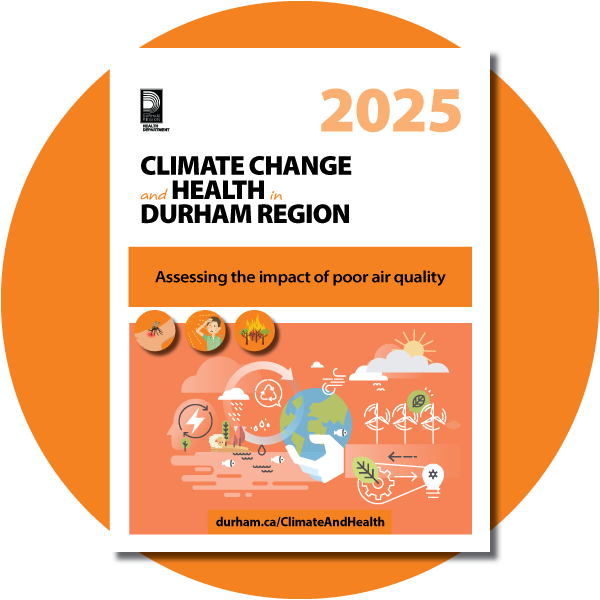 Assessing the Impact Poor Air Quality
Climate change is causing more frequent and intense climate hazards and increases the risk of climate shocks; sudden and significant changes in weather that can have severe and unpredictable consequences to our health. It also impacts the air, food, water, homes, land, communities, and health care systems that we depend on.
What are some of the health impacts of climate change?
Extreme heat
- Hospitalization
- Death
- Pregnancy complications
Extreme weather
- Injuries
- Respiratory disease
- Allergies
- Heart attacks
- Waterborne diseases
- Legionellosis
- Carbon monoxide poisoning
Air pollution
- Lung disease
- Allergies
- Cardiovascular disease
- Breathing difficulties
- Ear, nose and throat irritation
- Death

Food impacts
- Microbial food borne illness
- Reduced food availability
- Malnutrition and deficiencies
- Poor maternal and child health and development
- Chronic illness
Water contamination
- Gastrointestinal illnesses
- Waterborne diseases from bacteria and viruses
- Illness from toxic algae exposure
Vector-borne diseases
- Lyme disease
- West Nile virus
- Zoonotic diseases
UV
radiation
- Skin cancer
- Cataracts
Who is the most at risk?
Although everyone is affected by climate change some people face greater health risks than others.
- Health risks from climate change are related to many factors including age, income, access to health care, safe and stable housing and a healthy, inclusive, supportive community.
- Our understanding of risk factors is still developing, and many people experience more than one risk factor.
In general, at-risk populations include:
- adults over age 65,
- children and youth,
- people who are pregnant,
- Indigenous Peoples,
- racialized populations,
- people with disabilities,
- residents of remote communities,
- individuals who are socially and economically disadvantaged, and
- people with pre-existing physical or mental health challenges.
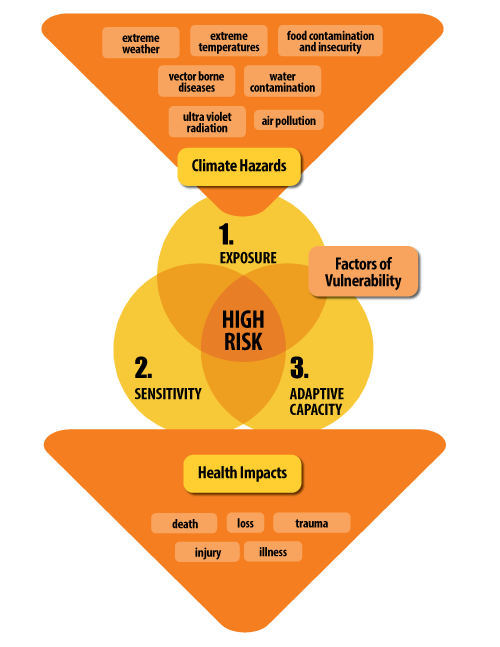
Let's explore how climate vulnerability is influenced by exposure, sensitivity, and adaptive capacity.*
Are you exposed to climate hazards? Some people and communities have greater exposure to climate hazards such as extreme heat or flooding because of where they live or work.
Are you sensitive to climate hazards? Some people are more sensitive to climate hazards because of their age or health. For example older adults and young children are more susceptible to heat-illness than others due to a reduced ability to regulate body temperature.
Are you able to protect yourself from climate hazards? The ability to protect yourself from climate hazards is called adaptive capacity. Harm from climate hazards can be prevented by improving the ability of people and communities to protect themselves.
The illustration (on the right) shows how these factors can determine a person’s risk of harm from climate hazards. *The term "vulnerable" can be stigmatizing. While factors of vulnerability are important for assessing risk, the term vulnerable as a label for individuals, communities or populations can be harmful.
Climate vulnerability
and health
 Download
What is Durham Region Health Department doing to protect residents from the impacts of climate change?
Durham Region is already experiencing the effects of climate change and there is an urgent need to be prepared for local health impacts now and in the future.
As part of the Ontario Public Health Standards (2021), Durham Region Health Department works to assess and address the health impacts of climate change. This involves monitoring emerging trends and priority populations and working with partners to reduce exposure to climate hazards. This includes:
- Durham’s Heat Warning and Information System (HWIS) and heat health safety initiatives.
- Air quality monitoring and guidance for minimizing health risks.
- Guidance on ultraviolet radiation exposure and sun safety.
- Flood prevention, preparedness, and health risks information.
- Monitoring, reporting and prevention of climate related infectious diseases such as Lyme disease and West Nile virus.
- Monitoring and reporting regional and neighbourhood health data to support strong, safe and equitable neighbourhoods.
- Climate change and health vulnerability assessments.
More Durham Region programs that promote health and climate change resilience
- Durham Greener Homes Program: helping Durham residents achieve more energy efficient homes and reduce green house gas emissions
- LEAF Backyard Tree Planting Program
- Durham Trees Program (rural tree planting)
Flood preparedness: Information to create a more flood resilient region
Durham Regional Plans to address climate change
Durham Region
Canada
- Mobilizing Public Health Action on Climate Change in Canada: The Chief Public Health Officer of Canada’s report on the state of public health in Canada 2022
- Health of Canadians in a changing climate: Advancing our knowledge for action
- Canada’s National Adaptation Strategy: Building resilient communities and a strong economy
Global